Choosing the Best Fireplace Fan for Your Colorado County
 Picking the best fireplace fan for your county comes down to two things: how cold your winters get and whether your power stays on when the wind kicks up. Colorado runs the gamut, from the snowed-in peaks of the Rockies down to the dry, gusty plains out east, so what works for a cabin in the high country isn't what I'd put in a Denver living room. Whether you're riding out a hard freeze in Summit County, dealing with temperatures that swing 40 degrees in a day in Boulder County, or just want a little more warmth on a crisp fall evening in Mesa County, the right fan makes the heat you're already paying for actually reach you.
I'm Adam. I've been sweeping and repairing chimneys around Denver and the front range since 2001, and I get asked about fireplace fans more than almost anything else once the temperature drops. This guide walks through the two main kinds of fans, which Colorado counties each one suits, what they cost, and how to set them up without wrecking them in the first season. If you'd rather just call and talk it through, the number's (720) 207-9232.
Why Colorado Homes Need a Fireplace Fan
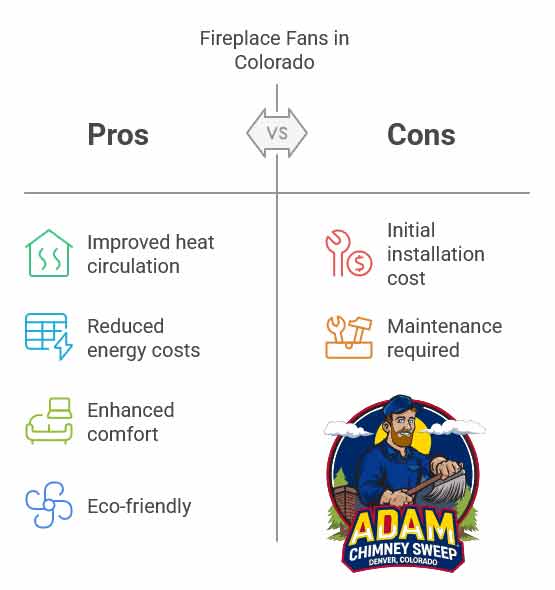
 Heat rises. That's the whole problem in one sentence. Plenty of folks around here lean on their fireplaces and wood stoves to get through January, but with no air moving, most of that warmth floats straight up and pools against the ceiling. You end up roasting if you're standing on a chair and shivering on the couch. A fan fixes that by pushing the warm air back out into the room where you live. Here's what a good one does for you:
- Spreads the heat: Warm air gets pushed out and down instead of stacking up by the ceiling, so the far corners of the room actually feel it.
- Cuts your fuel use: When the heat moves, you burn less wood or pellets to feel just as warm. Over a long Colorado winter that adds up.
- Evens things out: No more hot spot right by the stove and a cold zone ten feet away.
- Skips the power bill (the heat-powered kind): Stove-top fans run off the heat itself, so they cost nothing to operate and keep going if the grid goes down.
The thing nobody tells you is that a fan doesn't make your fire hotter, it just stops you from wasting the heat you already made. I've walked into mountain homes where the fire's roaring and the family's still cold because every bit of warmth is sitting up in the rafters. A forty-dollar stove fan would've fixed it. That's usually the cheapest comfort upgrade I can point someone to.
- Adam, Owner, Adam Chimney Sweep
Heat-Powered Fireplace Fans: Built for the Mountains
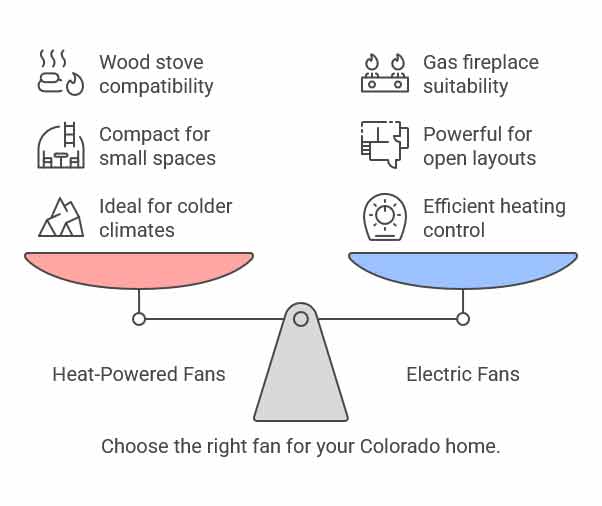
Heat-powered fans run on a clever little trick. There's no plug and no batteries. The temperature difference between the hot base sitting on your stove and the cooler air up top generates just enough electricity to spin the blades. The hotter the stove, the faster they go. When the fire dies down at night, the fan quietly slows and stops on its own. That makes them a natural fit for the high country, where outages happen and a lot of cabins run off-grid anyway.
Best Colorado Counties for Heat-Powered Fans
- Summit County (Breckenridge, Frisco, Silverthorne)
- It drops below freezing up here all the time, so a fan that keeps working when the power doesn't is worth its weight. Great for cabins and vacation places that sit empty between visits.
- Model worth a look: EcoFan AirMax — starts spinning at low stove temps and runs near silent.
- Gunnison County (Crested Butte, Gunnison)
- Gunnison regularly posts some of the coldest readings in the lower 48. You want every bit of heat spread around, and you don't want to spend extra power doing it.
- Model worth a look: Lehman's Heat-Powered Oscillating Fan — sweeps side to side, which helps in bigger rooms.
- San Miguel County (Telluride, Mountain Village)
- This ski country sees its share of outages. A heat-powered fan keeps the warmth moving even when the lights are out.
- Model worth a look: Voda 4-Blade Stove Fan — small, simple, dependable.
- Lake County (Leadville)
- At over 10,000 feet, the less you have to lean on the grid, the better. Self-powered heat just makes sense up there.
- Model worth a look: Caframo Ecofan BelAir — strong performer that holds up to the thin, cold air.
- Chaffee County (Buena Vista, Salida)
- Lots of off-grid retreats tucked into these valleys. A stove fan keeps temps even without touching your utility bill.
- Model worth a look: Tomersun 3-Blade Stove Fan — wallet-friendly and gets the job done.
Electric Fireplace Fans and Blowers: Made for Town
Electric fans plug in and give you steady, strong airflow no matter how hot the fire is. They're the right call where power isn't a worry, which is most of the front range. A lot of them come with speed dials, timers, and remotes, so you can fine-tune the airflow from the couch. If you've got a gas fireplace or an insert, an electric blower is pretty much your only option anyway, since gas doesn't throw off enough heat to run a stove fan.
 Affordable Electric Fans In Colorado
Best Colorado Counties for Electric Fans
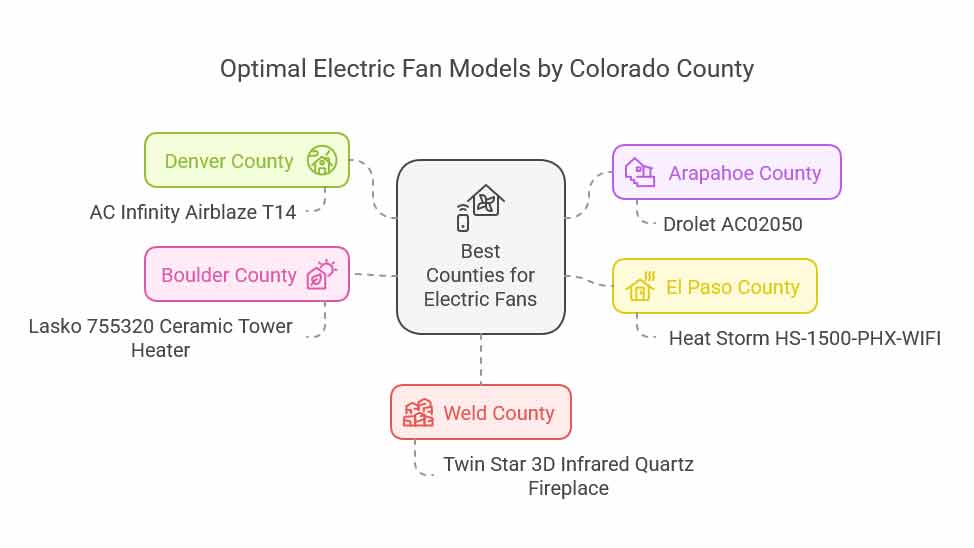
- Denver County (Denver, Stapleton, Cherry Creek)
- City homes with modern fireplaces and open floor plans need a fan with some muscle to move heat across the whole space.
- Model worth a look: AC Infinity Airblaze T14 — 10 speed settings and a clean digital readout.
- Arapahoe County (Aurora, Centennial, Highlands Ranch)
- Bigger two-story houses out here move heat better with a powered blower pushing it from room to room.
- Model worth a look: Drolet AC02050 — runs quiet and pushes a lot of air.
- El Paso County (Colorado Springs, Monument)
- Temps bounce around down here, so a fan that puts out the same airflow regardless of fire size keeps things comfortable.
- Model worth a look: Heat Storm HS-1500-PHX-WIFI — wall-mounted with remote control.
- Boulder County (Boulder, Longmont, Louisville)
- Tight, energy-conscious homes pair well with an electric fan that lets you dial in exactly how much air you want.
- Model worth a look: Lasko 755320 Ceramic Tower Heater — efficient and easy on the eyes.
- Weld County (Greeley, Fort Lupton, Windsor)
- Big homes with wide-open living areas need real airflow, and a high-output electric unit delivers it.
- Model worth a look: Twin Star 3D Infrared Quartz Fireplace — looks sharp and moves heat well.
Half my Denver and Aurora customers don't even realize their gas fireplace already has a blower slot built into it from the factory, just no fan installed. We drop the right unit in, wire it to the existing junction box, and suddenly the room heats twice as fast. If you've got a gas insert, an electric blower is the move every time. A heat-powered fan won't even spin on a gas burner, it doesn't get hot enough.
- Adam, Owner, Adam Chimney Sweep
Heat-Powered vs. Electric Fans: The Honest Trade-offs
There's no single winner here. It really depends on where you live and how your home is set up. This table lays out how the two stack up:
| Aspect | Heat-Powered Fans | Electric Fans |
|---|---|---|
| Energy Source | Self-powered by stove heat | Requires electricity |
| Operating Cost | Very low | Higher due to power consumption |
| Eco-Friendliness | High (no power needed) | Lower due to electricity use |
| Performance | Varies with the stove temperature | Consistent regardless of conditions |
| Ideal For | Off-grid, remote homes in mountain areas | Urban homes with easy power access |
 Which Fireplace Do You Have?
What to Check Before You Buy a Fireplace Fan in Colorado
Live in a high-altitude cabin in Clear Creek County or a tidy suburban place in Teller County? Either way, the fan that fits depends on a few things about your home and how you heat it. Run through these before you spend a dime:
- Altitude and how cold it gets:
- Higher up (think Pitkin, Eagle, and Lake Counties) the winters bite harder, and a heat-powered fan that keeps going through an outage is the safer bet.
- Lower down (Adams, Broomfield, and Jefferson Counties) you've got reliable power, so an electric fan with finer control is usually the better pick.
- Your floor plan:
- Open layouts like a lot of homes in Douglas County need a stronger electric blower to carry heat across the space.
- Snug cabins in Park County do fine with a compact heat-powered model.
- What you're burning:
- Wood stoves, common in Routt County, need good heat movement so you're not tempted to over-fire them.
- Gas fireplaces in Larimer County pair well with an electric blower you can adjust.
What a Fireplace Fan Actually Costs in Colorado
The price tag varies, but the math usually works in your favor once you factor in the fuel you'll save over a long heating season.
- Heat-powered fans run from $50 to $150, and after that they cost you nothing to run. They make the most sense in counties that burn hard all winter, like Summit and Gunnison.
- Electric fans range from $100 to $500. They use a trickle of power, but the precise heat control can trim your overall heating bill. Good fit for busier areas like Denver and Boulder Counties.
 Chimney Fan Installation And Repair
How to Install a Fireplace Fan: Step by Step
Once you've settled on the right fan, whether that's a heat-powered unit for your off-grid place in San Juan County or an electric blower for your house in Alamosa County , setting it up right is what keeps it running for years instead of months. Here's how I'd walk you through it.
1. Getting Ready
Before anything else, do a little prep so the fan starts off on the right foot:
- Clean out the firebox: Clear ash and debris from your stove or fireplace so air moves freely.
- Measure your surface: Check how much flat space you've got on top of the stove or on the mantel so the fan actually fits.
- Pick the spot: Heat-powered fans go on a flat, cool surface before you light the fire. For electric ones, find the closest outlet so the cord reaches without a mess.
2. Setting Up a Heat-Powered Fan
These are about as simple as it gets, but where you put it makes all the difference.
Steps:
- Place it: Set the fan on a flat, unheated surface before you light up. The back edge of the stove top usually works best.
- Build the fire slowly: Let the stove come up to temperature gradually so the fan kicks in as it heats (these typically start spinning around 50-65°C).
- Watch the airflow: The blades should start turning on their own. Nudge the fan around until the air's heading where you want it.
- Keep it clean: Check now and then for dust and wipe the blades with a soft cloth so it keeps spinning freely.
Best for:
- Rustic cabins in Archuleta County, where off-grid heat is the whole point.
- Mountain homes in Eagle County that need to run without leaning on the grid.
3. Setting Up an Electric Fireplace Fan
Electric units take a bit more planning, but you get more control in return.
Steps:
- Pick the right model: If you want the bells and whistles, look for variable speed, a timer, and a remote.
- Mount or place it: Follow the maker's instructions for fitting it in the fireplace or sitting it on the mantel, and route the cord so nobody trips on it.
- Plug in and test: Power it up, run it through the settings, and adjust the airflow until it feels right.
- Set the temperature sensor: A lot of electric models switch on and off based on fireplace temperature, so take a minute to set that up correctly.
Best for:
- Modern homes in El Paso County, where folks want tight control over their heat.
- Larger suburban houses in Jefferson County that need real airflow to stay warm.
One honest word of caution: if your fan ties into your home's wiring or sits inside a gas insert, get a pro to handle that part. A loose connection near a heat source isn't worth the risk. We do fan and blower installs all over the front range, so call (720) 207-9232 if you'd rather not climb into the firebox yourself.
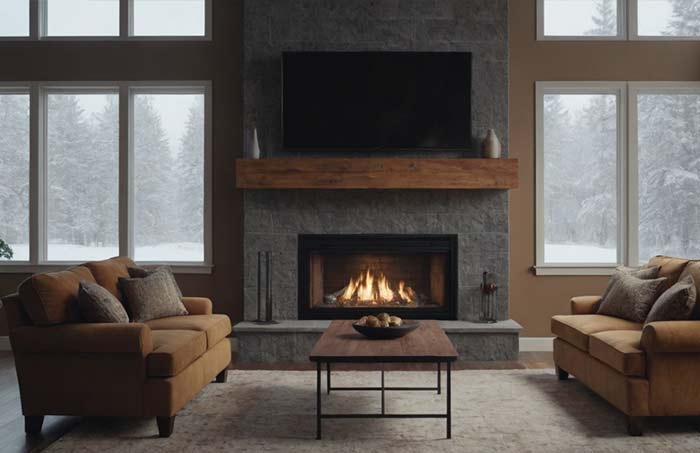 Choose The Right Fan For Your Colorado Home.
Keeping Your Fireplace Fan Running
A little upkeep goes a long way. Here's how I'd care for each type so it lasts.
Heat-Powered Fan Care
- Dust the blades: A microfiber cloth and a gentle hand are all it takes.
- Don't cook it: Keep the stove under the fan's max temperature so the unit doesn't warp or fail. Most have a little bimetal strip that lifts the base if it gets too hot, but don't count on it as a habit.
- Oil the moving parts: Now and then, a tiny dab of lubricant on the moving bits keeps everything turning smoothly.
Electric Fan Care
- Clean the filters: Some models have a filter that needs the occasional rinse or wipe to keep air flowing.
- Check the cord and controls: Look the power cord and switches over for any wear or fraying.
- Store it off-season: When summer rolls around, tuck the fan somewhere cool and dry so it's ready come fall.
Matching a Fireplace Fan to Your Climate Zone
Colorado isn't one climate, it's a dozen. Where you sit on the map changes what fan makes sense. Here's a quick reference for matching a fan to the conditions in different parts of the state:
| Climate Zone | Recommended Fan Type | Suitable Counties |
|---|---|---|
| Mountain/Cold Winters | Heat-Powered Fans | Summit, Lake, Gunnison, Pitkin |
| Urban/Moderate Winters | Electric Fireplace Blowers | Denver, Boulder, Arapahoe, Jefferson |
| Rural/Off-Grid Living | Dual-Motor Heat-Powered Fans | Park, Chaffee, Fremont, San Miguel |
| Plains/Windy Conditions | Electric Fans with High CFM | Weld, Morgan, Logan, Yuma |
| Eco-Friendly Homes | Heat-Powered Fans with Oscillation | Larimer, Douglas, Elbert |
See an Electric Fireplace Insert and Blower in Action
Wondering how an electric insert and its built-in blower actually push heat into a room? Here's a short clip from one of our Denver jobs showing exactly that, so you can see the airflow before you decide.
Fireplace Fan FAQs for Colorado Homes
If you're thinking about adding a fan, you've probably got questions about how they run, how much they save, and which one suits your stove. Whether you're trying to even out the heat in a cabin in Delta County or a home in Kit Carson County, here are the answers I give most often.
1. Can I Use a Fireplace Fan with Any Stove?
Mostly yes, but the type has to match your setup.
Heat-Powered Fans:
- These are made for wood stoves, pellet stoves, and coal-burning fireplaces. They run on the stove's own heat, which makes them a good fit for out-of-the-way spots like Hinsdale County and Moffat County, where the power gets flaky.
- Watch out for: The stove has to get hot enough (usually around 140°F) to spin the fan, so they won't work on a low-heat gas fireplace.
Electric Fans:
- Built for gas and electric fireplaces, these give you steady airflow no matter the temperature. They shine in homes in Prowers County and Rio Blanco County where folks want efficient, controllable heat.
- Watch out for: You'll need an outlet nearby, and they sip a bit of power, so expect a small bump on the electric bill.
Bottom line: Heat-powered for a hot wood or pellet stove, electric for gas or an electric fireplace.
2. Are Heat-Powered Fans Safe to Use Overnight?
They are, and that's one of the best things about them. Since they run purely off the stove's temperature, here's what happens when you turn in:
- As the fire dies down through the night, the fan slows and stops on its own. Nothing keeps running or overheats.
- There are no electrical parts to short out or spark, which makes them a safe pick for cabins in places like Washington County, where the fireplace might be the main heat source overnight.
- Built tough: Most are cast from aluminum, so they shrug off long stretches of heat without warping.
For overnight burns:
- Load enough wood to hold heat through the night.
- Set the fan toward the back of the stove so it isn't sitting in the hottest zone.
3. How Much Can a Fireplace Fan Cut My Heating Costs?
More than you'd guess, especially in the colder counties like Adams and Saguache, where heating eats up a big chunk of the budget.
What you might save:
- Heat-Powered Fans: By keeping air moving, they can trim wood or pellet use by as much as 20%, so you burn less for the same warmth.
- Electric Fans: By spreading heat evenly, they cut how often you reach for a space heater, which can knock 10-15% off your heating bill in bigger homes like those in Jefferson County.
How they pull it off:
- They stop heat from rising and getting stuck at the ceiling.
- They push warmth evenly across more than one room.
- They cut down on the need for extra heaters running in the background.
If you burn wood, it's also worth reading up on clean, efficient burning practices. The EPA's Burn Wise program has solid, no-nonsense guidance on getting more heat out of less wood, which pairs nicely with a good fan.
4. What's the Best Fireplace Fan for Off-Grid Homes?
If you're off the grid in a county like San Miguel, Pitkin, or Park, go heat-powered. No plug means nothing to lose when the power's unreliable or just isn't there.
My top pick: Lehman's Heat-Powered Oscillating Fan
- Why it works off-grid:
- Runs on heat alone, no electricity needed.
- The oscillating sweep spreads warmth wide without drawing any extra power.
- It's quiet, which is nice in a remote, peaceful spot like Highlands Ranch, CO.
A couple of others:
- EcoFan AirMax: Pushes good air even when the stove's only moderately warm, handy for milder winters.
- Tomersun 3-Blade Stove Fan: Compact and efficient, a nice match for the smaller wood stoves you find in off-grid cabins.
5. Do Electric Fireplace Fans Make a Lot of Noise?
The good ones are built to run quiet, which matters in town and the suburbs, places like Boulder County and El Paso County where you don't want a constant hum in the background.
What affects the noise:
- Speed setting: Crank it to the top speed and you'll hear more air moving.
- Build quality: Bargain models tend to have louder motors, while a well-made unit like the Drolet AC02050 runs close to silent.
- How it's mounted: A solid, level install cuts the rattle and vibration that make a fan sound louder than it is.
Quietest models out there:
- Drolet AC02050: Whisper quiet, fine for a bedroom or family room.
- AC Infinity Airblaze T14: Built with noise-cutting tech and barely audible.
- Voda Whisper Quiet Blower: Made for people who want next to no sound at all.
To keep it quiet:
- Wipe the blades regularly, since dust throws off the balance and adds noise over time.
- Make sure the fan sits flat and steady so it can't rattle.
- Run a lower speed when you want things calm.
I get calls every winter from folks convinced their new fan is broken because it's loud, and nine times out of ten it's just sitting on an uneven hearth or the blades are caked in dust from last season. Level it out, give the blades a quick wipe, and the rattle's gone. Before you box one up to return it, check those two things. Saves a lot of people a return trip and a refund hassle.
- Adam, Owner, Adam Chimney Sweep
A Few More Common Questions
6. Do Fireplace Fans Work in Open-Concept Homes?
Yes, and they're especially handy in big open layouts like a lot of homes in Douglas County, where heat scatters fast without something pushing it.
7. How Do I Clean and Maintain My Fireplace Fan?
Both kinds want the same basic care: dust the blades, clear any blockages, and make sure the moving parts turn freely.
8. Can a Fireplace Fan Overheat?
Heat-powered fans take a lot of heat, but parking one right in an intense hot zone (over 650°F) will shorten its life. Keep it toward the cooler back edge.
9. Are There Fireplace Fans for Outdoor Use?
Some electric models are rated for outdoor fireplaces, which is nice for patios in counties like Mesa and Larimer, where folks gather outside.
10. Where Can I Buy the Best Fireplace Fan in Colorado?
You'll find good ones at local stores like Home Depot and Lowe's, or specialty shops like Rocky Mountain Stove & Fireplace.
Where to Buy Fireplace Fans in Colorado
Whether you're up in the mountains of Routt County or out in the suburbs of Douglas County, here's where to find a fan locally or online:
- Home Depot (Denver, CO) – Solid range of both electric and heat-powered fans.
- Lowe's (Colorado Springs, CO) – Often has good prices on the major brands.
- Rocky Mountain Stove & Fireplace (Boulder, CO) – Specialty shop with people who know their stuff.
- Amazon & Wayfair – Easy online shopping with plenty of reviews to read.
Not sure your existing fireplace or flue is ready for a fan, or whether it's safe to run hard all winter? It's worth a quick look first. A chimney inspection catches the small stuff before it becomes a big repair, and we can tell you right then which fan setup fits your home.
Stay Warm with the Right Fireplace Fan for Your Colorado Home
From the snowed-in peaks of Summit County to the windy plains of Weld County, a fan is one of the simplest ways to get more comfort and lower bills out of the fireplace you already have. Match the model to your home and your county, and you'll feel the difference all winter.
Wrapping Up: Picking Your Colorado Fireplace Fan
Wherever you are in Colorado, whether it's the slopes above Summit County, the streets of Denver, or the open country around Mesa County, the right fan makes your home warmer and your wood pile last longer.
The Short Version:
- Heat-powered fans are the move for mountain counties and off-grid living.
- Electric fans give you strong, adjustable heat for homes in town and the suburbs.
- Weigh your climate, altitude, and floor plan before you choose.
Got questions about your specific setup, or want us to handle the install? Reach Adam and the crew at (720) 207-9232, or check out our full chimney and fireplace services. We've been keeping front range homes warm since 2001, and we're happy to help you do the same.